
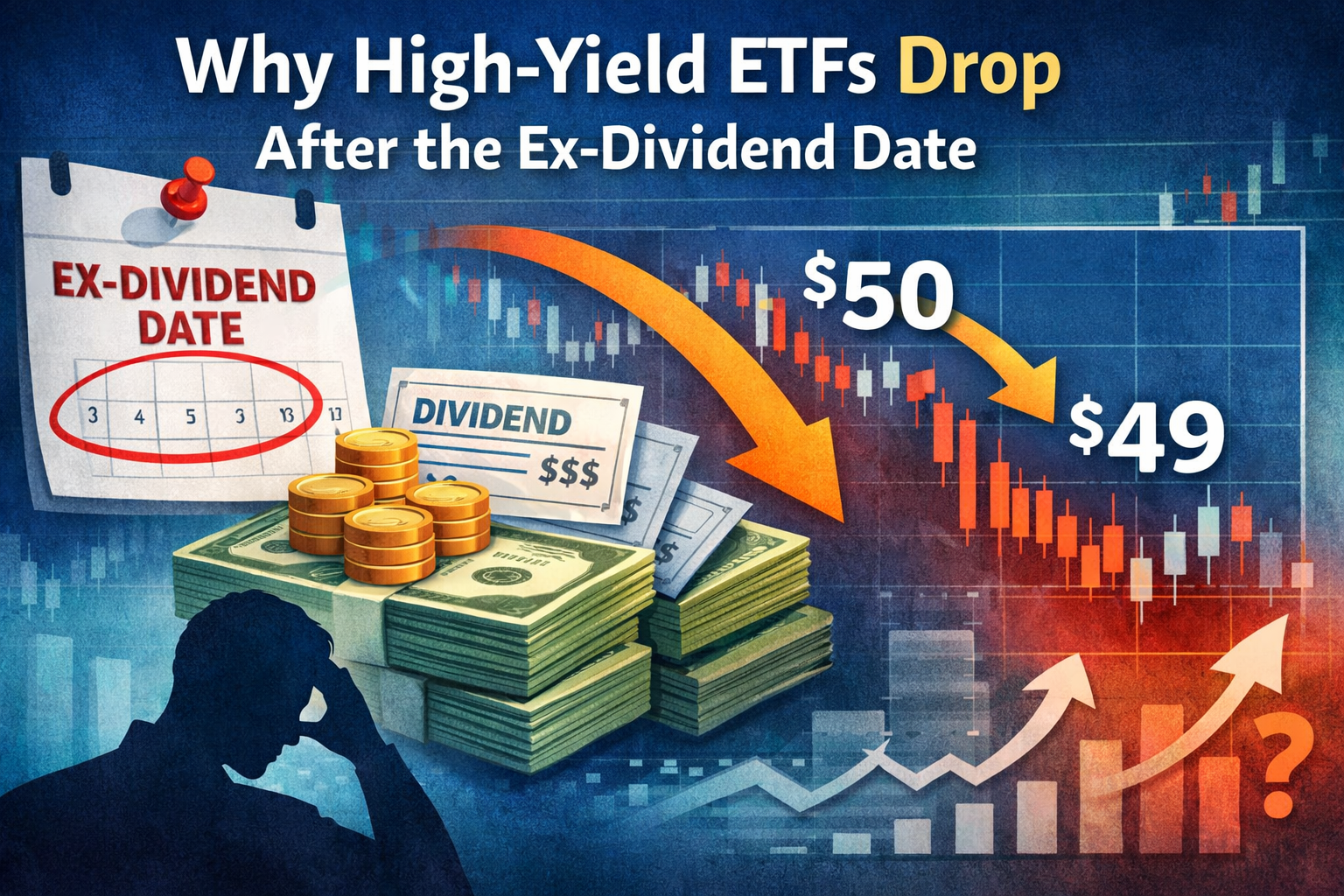
👉 Why High-Yield ETFs Always Drop After the Ex-Dividend Date
If you’ve ever watched a high-yield ETF right after its ex-dividend date, you’ve probably noticed something that feels… wrong.
👉 The price drops.
For many investors, this raises a frustrating question:
“Did I just lose money right after getting a dividend?”
Let’s break down exactly what’s happening — and why this is not only normal, but something smart investors can actually use to their advantage.
📅 What Is the Ex-Dividend Date? (Quick Explanation)
The ex-dividend date is the cutoff point that determines who receives the next dividend payment.
- If you own the ETF before the ex-date → you get the dividend
- If you buy on or after the ex-date → you do NOT get the dividend
That’s it.
But here’s the key:
👉 On the morning of the ex-dividend date, the market automatically adjusts the price.
📉 Why the Price Drops (The Mechanics)
This is where things click.
When a dividend is paid, money leaves the fund.
So the market reflects that instantly.
👉 Example:
- ETF price before ex-date: $50
- Dividend: $1
On ex-date:
👉 New price ≈ $49
Why?
Because that $1 is no longer inside the fund — it’s being paid out to shareholders.
🔍 Real Examples
JPMorgan Nasdaq Equity Premium Income ETF (JEPQ)
- Monthly payer
- Dividends often range from ~$0.30 to $0.50
- Frequent visible price drops after ex-date
👉 Because income is high, the drop is more noticeable
Schwab U.S. Dividend Equity ETF (SCHD)
- Quarterly payer
- Lower yield (~3–4%)
- Smaller price adjustments
👉 Same principle — just less dramatic
⚠️ Why This Matters for Income Investors
This is where many investors get tripped up.
They think:
👉 “I’ll buy right before the dividend and make easy money”
But in reality:
- You receive the dividend
- The price drops by roughly the same amount
👉 Net effect = roughly neutral (before taxes)
So chasing dividends alone doesn’t create instant profit.
🧠 The Real Insight Most Investors Miss
The drop itself isn’t the opportunity.
👉 The pattern is.
With high-yield ETFs like JEPQ:
- Dividends vary monthly
- Price drops vary
- Recovery timing varies
These patterns can reveal:
- Income stability
- Volatility trends
- Entry opportunities over time
⚖️ Strategy: Ignore It vs Exploit It
✅ Strategy 1: Ignore It (Long-Term Income Investors)
If your goal is:
- Monthly income
- Long-term compounding
👉 Then this drop is just noise.
You focus on:
- Total income over time
- Reinvestment (DRIP)
- Consistency of payouts
🚀 Strategy 2: Exploit It (Active Investors)
Some investors try to use this pattern:
- Buy after the drop
- Capture recovery
- Repeat over time
But this requires:
- Tracking ex-dates
- Watching price behavior
- Understanding yield changes
👉 This is where most people fall short — because the data changes constantly
📊 The Smarter Approach
Instead of guessing or manually tracking everything…
Smart investors monitor:
- Ex-dividend dates
- Dividend amount changes
- Yield shifts
- Price movement patterns
👉 Because the edge isn’t the dividend — it’s the changes around it
🚀 Final Takeaway
High-yield ETFs don’t “lose value” after the ex-dividend date.
They’re simply:
👉 Returning cash to shareholders
The price drop is:
- Expected
- Mechanical
- Predictable
But the real opportunity comes from understanding how those changes behave over time.
👉 Call to Action
If you want to track ex-dividend dates, dividend changes, and price behavior without spreadsheets:
👉 DiviPulse makes it simple.
See what’s changing — and stay one step ahead.
Stop guessing your income. Track it.
👉 Try DiviPulse and see your dividend income, changes, and trends in one place.